Research
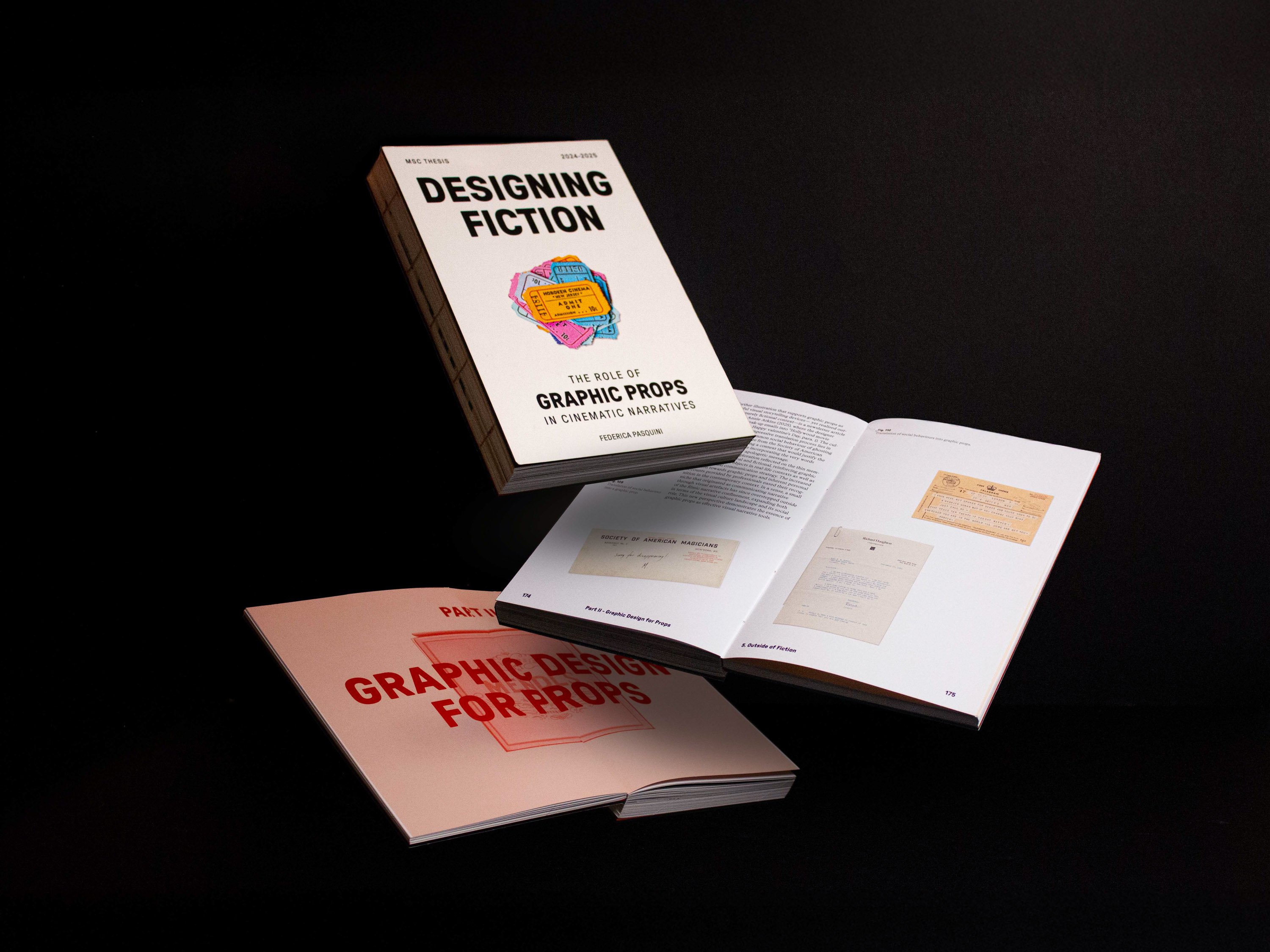
Here is a summary of the Master’s Thesis in Communication Design at Politecnico di Milano titled Designing Fiction: The Role of Graphic Props in Cinematic Narratives.
Graphic design for filmmaking
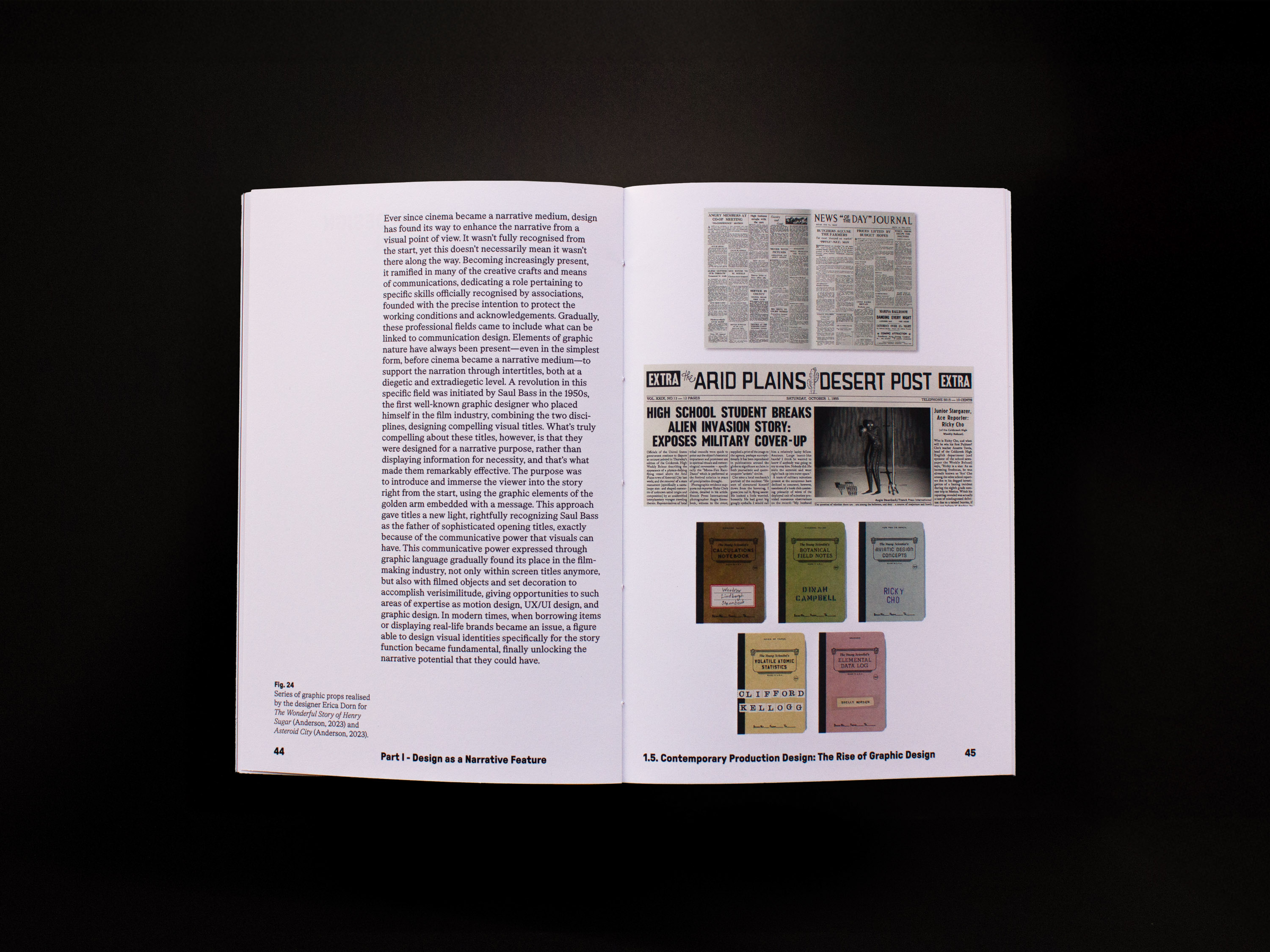
In more recent years, a new role started to emerge and be a presence in the art departments, the team responsible for the visual aspects of production: graphic designers. Before a more official recognition of the role, tasks like these would have been divided between members of the art department, usually falling on an assistant art director or on the set designer. However, as productions have become bigger and more demanding, the role of the graphic designer has evolved from a relatively new addition to the industry into an essential part of a dedicated graphics department. More broadly, visual design inserted itself in cinema as either a scenographic element—commonly referred to as graphic props.
Props and set
Props are physical objects used by actors or present on set. Their primary function is to maintain the illusion of the narrative unfolding naturally. They contribute significantly to shaping the setting, revealing characters, impeding or enabling actions, ultimately influencing the plot. The German etymology behind the term for a film prop specifically—Requisit—refers to something essential to and required by the film, something it cannot function without, just like the actors and the set.
The set is also an important part of the mise-en-scène, meaning that every component of the set becomes inevitably significant and invites the audience to an interpretation. While not every set will communicate something crucial about the narrative, they will not be neutral in terms of style, and the audience may perceive it differently, depending on their intertextual associations and the retrospective narrative.
What is a graphic prop?
A graphic prop can be regarded as a communicative artefact that, within the cinematic context, functions as a prop, designed to enhance the storytelling process. Originating from a communication design approach, graphic props typically contain textual and visual elements that need to be organized to convey a certain message, either to sustain the illusion or to unfold the events of the story. Their form is shaped by the diegetic elements of the story, like genre, time and place, characters, and events.
it is not intended to be a clear-cut definition, but rather an attempt to open a discussion on the matter.
Translation process
Drawn in film context, these artifacts are the result of an intentional act of shaping meaning: props like newspapers, signage, tickets, logos, posters require design, because they’re not just decoration—they are informational devices about the narrative. As narrative informational devices, they not only have to communicate effectively, but also belong to the fictional world—their form, language, and aesthetic must resonate with the film’s time, place, and mood. The narrative function of a graphic prop is translated from an invisible dimension, the script, into a visible artifact. It communicates a message through a variable graphic form, often involving text and image-related content.
Research question
This research addresses the question: how do graphic props contribute to the storytelling of audiovisual works? The answer emerged through the identification and categorization of their narrative functions. Exploring the functions that graphic props fulfill can improve the design process and the relative outcome, while acknowledging the potential these props have within the narrative.
Functions
The categories of narrative functions applied to graphic props identified are causal, thematic, character, set, mimetic, visual support, and enrichment.
The causal function refers to a prop that causes or enables a pivotal narrative event, without which the next key development in the story could not occur.
The thematic function is fulfilled when a graphic prop conveys abstract, symbolic, or metaphorical meaning that transcends its ordinary identity. This meaning must contribute to the film’s broader themes; therefore, offering symbolic weight in the diegetic logic is not sufficient to fall in this category. The character function serves to reflect a character’s personality, values, or development. Props and set elements help define or describe characters through their visual properties. They function as instruments of description—descriptors of a character’s identity, like social and family background, personal taste, and character traits. The set function situates the story in space, time, or atmosphere. It includes spatial anchors as well as ambient elements that contribute to mood and realism. The mimetic function concerns props physically manipulated by characters, contributing to realism or naturalism. These objects do not necessarily advance the plot or thematic dimension but help ground the scene in believable action. The visual support function reinforces or clarifies information conveyed in other filmic channels, such as visual, spoken, or musical. It supports the current moment being narrated, without introducing narrative content independently.
The enrichment function introduces new, standalone information not conveyed elsewhere in the scene. It may enrich the story world, hint at subplots, or embed symbolic depth.
A prop that introduces new, standalone information not conveyed elsewhere in the scene. It may enrich the story world, hint at subplots, or embed symbolic depth. These are independent configurations that reward active viewer interpretation.
A prop that significantly impacts the progression of the plot by enabling or triggering key narrative events — regardless of whether it performs its regular function or attracts attention.
A prop that conveys abstract, symbolic, or metaphorical meaning that transcends its ordinary identity. Its significance often arises through interpretation and contributes to broader narrative themes.
A prop that reflects a character’s personality, values, or development. It acts as an index of character traits or evolution, often through indirect or visual means.
A prop that situates the story in space, time, or atmosphere. It includes spatial anchors (e.g. era, geography) as well as ambient elements that contribute to mood and realism.
A prop physically manipulated by characters in ordinary ways that contribute to realism or naturalism. It does not advance the plot or theme but grounds the scene in believable action.
A prop that reinforces or clarifies information conveyed in other filmic channels (visual, spoken, musical). It may function redundantly (repeating info) or complementarily (clarifying it), but it does not introduce new narrative content independently.
To see how these functions are applied in practice, visit the archive.
Considerations
The functions presented offer a structured yet open framework for analyzing the narrative roles of graphic props. While the functions have been introduced individually, they are not intended to operate in isolation or to stick to specific objects. Instead, props often perform multiple, overlapping roles, and their meaning is shaped by their material gestures and their integration in context.
This framework encourages dynamic interpretation, to see graphic props as active narrative agents. As such, it should not be considered prescriptive, but rather a tool for generating questions—about how design interacts with storytelling, how visuals convey plot or theme, and how narrative meaning emerges from even the most peripheral elements on the screen.
Further Reading
Atkins, A. (2020). Fake love letters, forged telegrams, and prison escape maps. Phaidon Press.
Chatman, S. (1980). Story and discourse: Narrative structure in fiction and film. Cornell University Press.
Gorfinkel, E., & Rhodes, J. D. (2025). The prop. Fordham University Press.
Ryan, M.-L., & Weisheng, T. (2024). Object-oriented narratology. University of Nebraska Press.
Seitz, M. Z. (Director). (2009, March 30). The substance of style (part 4) [Video recording]. Internet Archive. https://archive.org/details/substance-of-style/wes_anderson_4.mp4